
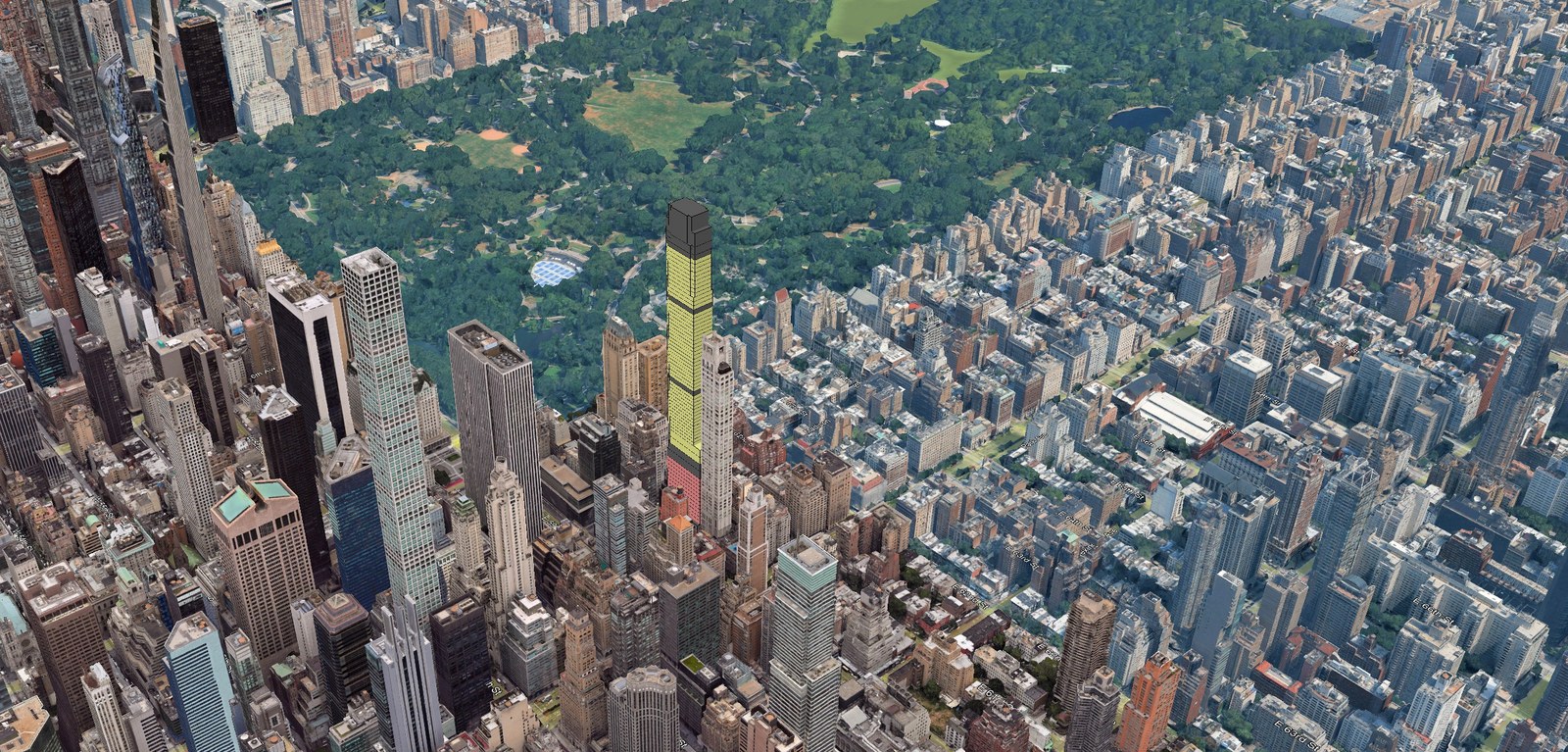
A rendering of the proposed building at 655 Madison Avenue (highlighted), shown at full height against Central Park and the Upper East Side. The building is projected to contain 154 housing units; HPD’s draft target for Community District 8 amounts to roughly 82 buildings of this size in terms of housing units to be built on the Upper East Side over five years.
The NYC Department of Housing Preservation and Development (HPD) has released a draft Fair Housing Growth Strategy, a citywide plan mandated by Local Law 167 that sets five-year housing production targets for every Community District. The plan is intended to advance fair housing and help address the city's affordability crisis.
FRIENDS supports housing equity and recognizes the urgent need for more affordable housing throughout New York City. But we have serious concerns about the methodology used in the draft report, and the resulting target for the Upper East Side.
A Target Out of Step With Reality
The draft calls for 12,725 new housing units in Manhattan Community District 8 (the Upper East Side and Roosevelt Island) by 2030, which would be a 9.1% growth rate. Between 2020 and 2025, the district added just 1,623 net units, or 1.2% growth. The new target asks for nearly eight times that pace, in an already dense residential neighborhood with relatively little vacant or underutilized land left to build on.
The draft designates Community District 8 as a “low-growth” district based on its recent housing production, while also applying a higher target because it is considered a “limited affordability area.” But this methodology does not adequately account for the fact that the Upper East Side is already one of the densest areas in New York City, and it does not consider the different circumstances of neighborhoods across the city.
Adding thousands of new units to an already extensively developed residential neighborhood is fundamentally different from adding housing in areas with large amounts of underutilized land.
Planning for New Housing—and Protecting Existing Housing
FRIENDS is particularly concerned that the draft strategy focuses on new housing production without adequately accounting for the potential loss of existing housing, the risk of displacement, or the capacity of neighborhoods to absorb new growth.
Local Law 167 doesn’t just ask HPD to set housing targets. It requires the City to weigh specific planning criteria, including displacement risk, access to transit, availability of open space, and the capacity of infrastructure and public services to support new growth. The draft strategy, however, leans heavily on recent housing production and does not adequately consider these other factors.
That gap matters enormously on the Upper East Side. Much of CD8’s transit, sewer, and school infrastructure is already heavily utilized, with no comparable expansion planned to support a 9.1% growth target. And because there is so little vacant or underutilized land, meeting that target is likely to place the greatest development pressure on lower-rise, older buildings along the avenues, including tenements.
FRIENDS has long argued that these buildings provide relatively affordable housing and should be preserved as an important part of the city’s housing stock. When they are demolished, residents can be displaced and relatively affordable homes can disappear, often replaced by fewer, much more expensive units. As we have documented, more buildings do not necessarily mean more housing, and more housing does not necessarily mean more affordable housing.
A meaningful housing strategy should therefore consider not only how many new units can be added, but also what existing housing may be lost, who lives there, and whether new development actually expands housing opportunities for the New Yorkers who need them most. Preserving the relatively affordable housing we already have should be part of the equation.
More Housing ≠ More Affordable Housing
Of the 12,725 new units projected for Community District 8, approximately 75 percent would be market-rate. The target includes 3,180 affordable units, including 955 deeply affordable units and 475 units for formerly homeless households. Even within the affordable housing component, however, a significant share would be targeted to income levels that remain out of reach for many lower-income New Yorkers.
FRIENDS agrees that New York needs more housing, but building more market-rate housing will not solve the affordability crisis. A strategy billed as advancing fair housing should say far more about what income levels new housing will actually serve and must also consider where truly affordable housing can be built without displacing existing residents.
What Should Change
FRIENDS agrees every neighborhood has a role to play in meeting the city's housing needs. But equity also means recognizing that neighborhoods have different physical conditions, existing densities, housing stock, infrastructure, and available land. It cannot be achieved by applying a one-size-fits-all growth formula.
We urge HPD to:
- Revisit the Community District 8 target using the full set of planning criteria Local Law 167 requires, including transit access, open space, and infrastructure and public service capacity, not just recent production numbers
- Account for displacement risk and the loss of existing, relatively affordable housing
- Put real weight behind genuinely affordable housing, not market-rate volume, as the measure of success
HPD is accepting public comments through September 19, 2026. Submit your comments here.