
The Upper East Side has long been defined by its elegant scale: limestone townhouses, landmark clubs, and refined prewar apartment houses forming a cohesive, human-scaled skyline. But that familiar silhouette is shifting. A new generation of supertall towers — some soaring well beyond 1,000 feet — is pushing north from Midtown and reshaping the neighborhood’s identity. Even just beyond the UES line, projects like the proposed 1,240-foot tower at 625 Madison Avenue illustrate how supertalls are edging ever closer, pressing against the district’s boundaries.
Driving this transformation is a powerful and increasingly controversial tool: the transfer of development rights, or “air rights.” Originally intended to support the preservation of landmarks by allowing unused development potential to be sold to adjacent sites, TDRs have evolved into a mechanism capable of creating tremendous new height where it was never envisioned. In effect, it is a tool that can generate value out of thin air.
655 Madison Avenue Supertall
One of the most dramatic proposals now confronting the UES is Extell’s planned tower at 655 Madison Avenue, a 72-story mixed-use supertall on 60th Street between Madison and Park Avenues. The zoning application is available for review here. Two design scenarios are under consideration: an as-of-right version and one that requires approval from the City Planning Commission.
The as-of-right tower would rise to 1,279 feet, tapering slightly as it ascends (Version 1: As-of right). If approved by the CPC, however, the alternative version would create a more monolithic, rectangular tower with no slimming at the top, reaching 1,162 feet (Version 2: Requires CPC approval) and delivering 764,698 square feet of residential, office, and retail space.
This proposal depends heavily on a transfer of development rights from the landmarked Metropolitan Club at 1 East 60th Street. Before City of Yes, such a transfer could move only to directly adjacent blocks; under the new rules, it may extend across nine surrounding blocks, dramatically expanding where massive new buildings can rise.
FRIENDS is deeply concerned about the overwhelming height and scale of this proposal and the precedent it sets for the neighborhood. Why this matters for preservation and scale:
- At over ~1,100 feet, the tower would dwarf the existing built context along Madison Avenue and East 60th Street, creating an abrupt new visual dominance. It would even eclipse the 781-foot-tall 520 Park Avenue residential tower from Robert A. M. Stern Architects standing directly beside it.
• The reliance on substantial air-rights transfers means that the latent development potential of smaller buildings is being consolidated into a single, very large structure.
• Even when donor sites are legally permitted, the cumulative effect shifts the balance between historic, low-rise architecture and their increasingly tall neighbors — placing the historic context at risk of being overshadowed.
• Loss of context: Buildings designed for a specific architectural scale and streetscape are altered when situated beside or beneath supertalls, changing how they are perceived in terms of light, proportion, and visibility.
• Shadows and light: Super-tall towers cast long shadows and reduce sky exposure for nearby public spaces and residences. Technical compliance does not prevent meaningful changes to daily life.
• Infrastructure and public-realm mismatch: Areas built around a mid-rise urban fabric are rarely equipped to absorb the impacts of supertall development on streets, transit, services, and congestion.
• Equity and access: Many supertalls serve the ultra-luxury market and provide no affordable housing, further altering the social balance of the neighborhood.
The Upper East Side is entering a pivotal moment. Towers exceeding a thousand feet are no longer confined to the Midtown supertall corridor; they are moving deeper into a district long cherished for its human-scaled character and layered architectural heritage. Without deliberate action by residents, preservation advocates, and policymakers, the neighborhood risks trading its historic context for sheer height. And once a skyline changes, it rarely changes back.
Read More:
- NYC City Planning Comissions Zoning Resolution, 75-422: Certification to transfer development rights from landmarks
- FRIENDS's testimony for the transfer of development rights from the Metropolitan Club.
- City of Yes for Housing Opportunity Transfer of Development Rights for Landmarked Buildings.

Version 1: As-of-right
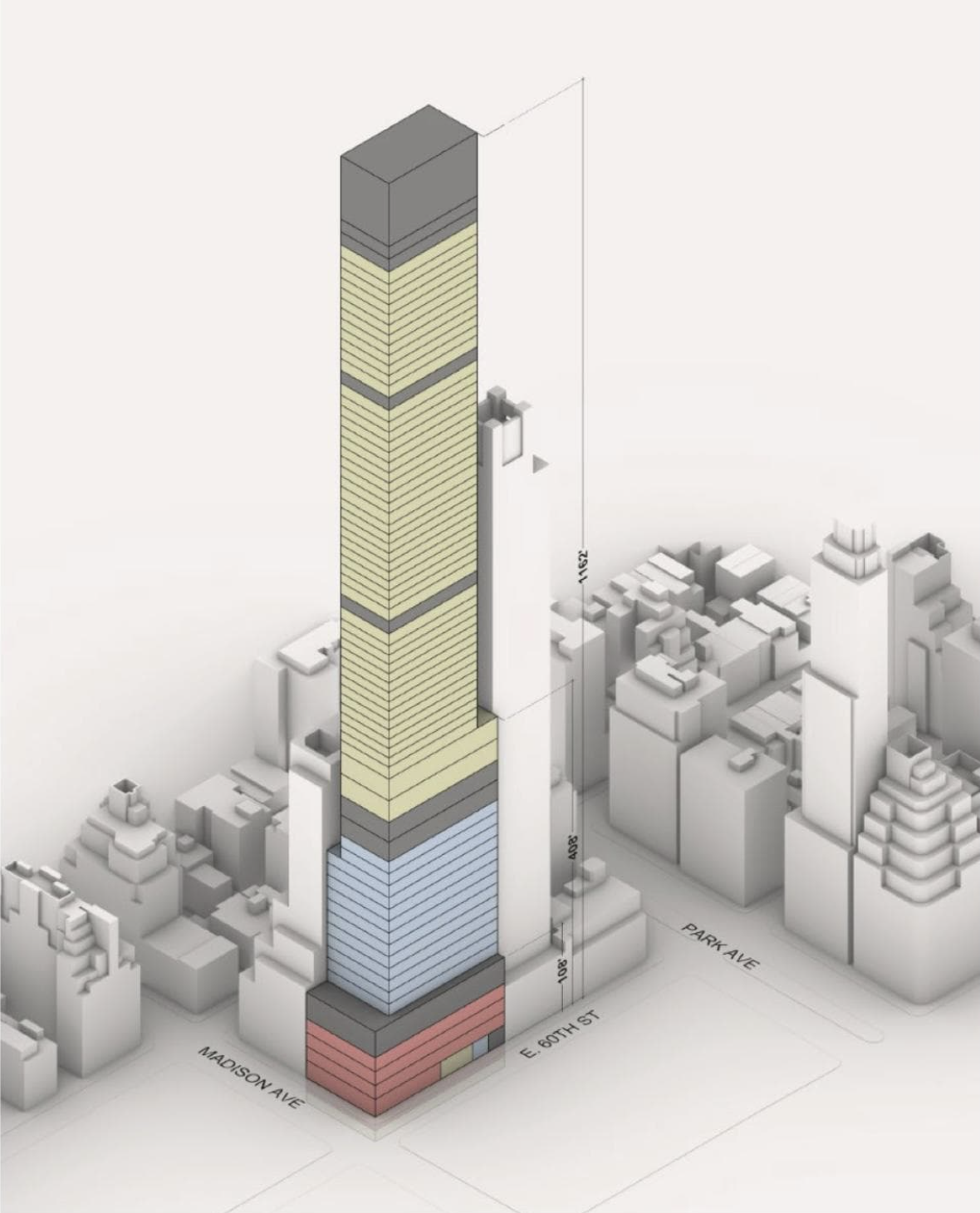
Version 2: CPC approval required
